
Reviewed · THE TROUBLES HISTORY TOURS
1 Hour Express Belfast Taxi/Cab Tour History, Murals, Troubles
This is one of the best ways to understand Belfast fast, without reading a book first. In about an hour, you’ll ride past major murals and conflict-era sites, and your driver tells the story in a direct, lived-in way. I especially like that it’s a private tour for just your party, and that the taxi drivers share details they grew up with, like Brendan did. One thing to consider, this tour deals with the Troubles, so it’s intense even when it’s brief.
You’ll start at a central spot, usually with pickup from centrally located hotels, then jump straight into the neighborhoods where the murals, walls, and landmarks do the talking. It’s offered in English, and the taxi is air-conditioned, which is a nice practical touch.
The route is short by design. That’s great for first-timers, but you’ll want to follow up later if you catch one topic that really grabs you.
Key highlights to expect
- Private taxi, local driver storytelling that keeps the pace human, not museum-fast
- Central pickup and a tight 1-hour loop that fits even busy itineraries
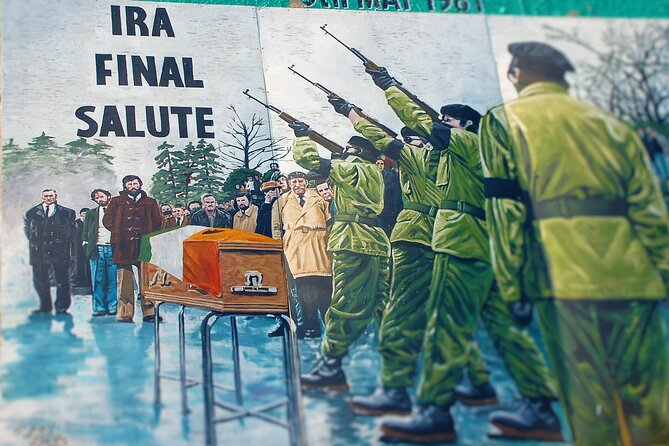
- Falls Road murals, including the Bobby Sands mural and its famous line, Our revenge will be the laughter of our children.
- Peace Wall viewing and signing at the world-famous Belfast Peace Walls
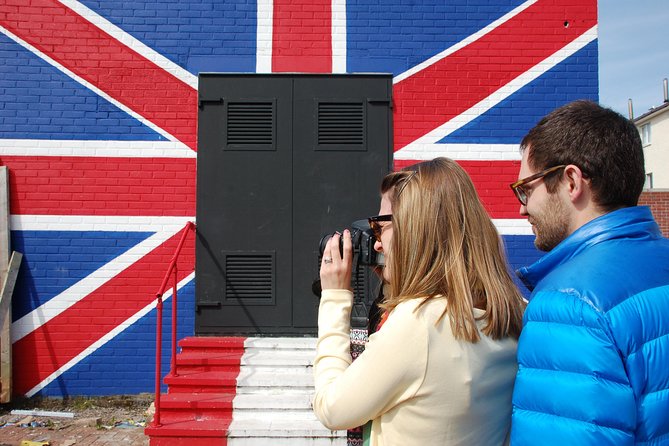
- Shankill Road murals tied to loyalist paramilitary groups active during the Troubles
- Photo included, so you don’t have to manage one more task on the day
Belfast Black Taxi + Murals in 1 Hour: Why This Works
If Belfast feels complicated, you’re not wrong. The city carries layers that show up in buildings, street art, and even how people talk about neighborhoods. This tour works because it treats those layers like a real conversation. You’re not just looking at murals, you’re learning what they meant to local life and why they still matter.
The biggest win is the format. A black taxi ride keeps you moving, and a local driver keeps it grounded. You get context while you’re actually passing the places, which helps your brain connect the dots quickly. And since it’s private, your driver can slow down for the topics you care about, instead of covering everything for a mixed group.
The second win is that it’s short, about 1 hour. When you’re dealing with heavy subject matter, it helps that you’re not stuck for hours. You get the overview, then you can choose how much more to read or visit afterward.
One small trade-off: because it’s fast, you’ll probably leave with questions. That’s a good sign. It just means you should plan for a little follow-up on your own.
Other Troubles history tours, told plainly:
- Belfast’s Political Mural Taxi Tour
★ 5.0 · 1,180 reviews - Belfast Troubles Tour: Walls and Bridges
★ 5.0 · 853 reviews - Belfast Political Tour-Conflicting Stories Walking Tour
★ 4.5 · 459 reviews
Getting Set Up: Where You Start and How Pickup Fits
The starting point is the Leonardo Hotel Belfast on Great Victoria Street. The tour typically ends back near the same meeting spot, so you’re not left figuring out your route after the last stop.
A key practical feature is pickup. The experience includes pickup from most centrally located Belfast hotels, so you’re not forced to drag yourself across town with time pressure. You can also choose a departure time that matches your schedule, which is helpful if you’re pairing this with other Belfast plans.
You’ll receive a mobile ticket, and the tour is offered in English. It’s also described as near public transportation, so even if your hotel pickup is not available, you should still be able to reach the start area easily.
Inside, you’ll be in an air-conditioned vehicle, which matters because Belfast weather can change quickly. On a short ride, comfort is more than comfort, it keeps you focused on what you’re seeing instead of thinking about the cold.
Falls Road Library: Bullet Holes, Occupation, and the Pause That Matters
The tour begins in the Falls Road area, starting with a stop at the Falls Road Library. This is one of the most sobering moments on the route because the site is literally marked by history. The library is described as having bullet holes from gun battles involving British Army forces that occupied the building.
That detail changes how you look at everything else later. You stop treating the Troubles as old headlines. You start understanding it as something that shaped daily life, and sometimes left physical scars.
Right across the way, you get a shift from damage to messaging, the kind you can read at street level. The proximity matters because it shows how Belfast kept recording its conflict, not only in official structures but in the neighborhood landscape too.
If you’re someone who prefers to understand before you judge, this is where the tour sets the tone. Your driver can connect the library scene to the wider period of conflict, including how control changed from earlier forces referenced at the site to the British Army occupation. You’ll likely hear explanations that help you place what you’re seeing into a timeline.
Possible drawback? Because this stop is heavy, you might feel a little rushed if you’re hoping for a long, quiet moment. The tour is built for an hour, so take a minute, look closely, then let your driver keep moving at a respectful pace.
The Bobby Sands Mural on Falls Road: Symbol, Text, and Meaning
Next comes one of Belfast’s most iconic murals, the Bobby Sands mural. It’s located on the side of Sinn Féin’s Belfast headquarters on Falls Road, and it’s part of a broader series of murals connected to the Irish Republican movement.
The mural features Sands’ portrait and points you to his story: he was an IRA member who died on hunger strike in 1981 while imprisoned in the H block Prison. That background matters because it explains why the portrait is not just art, it’s a political statement and a memorial.
Then there’s the line included on the mural, Our revenge will be the laughter of our children. It’s the kind of quote that can sound distant if you only read it on a postcard. In context, your driver’s interpretation helps you understand it as a claim about future generations and what resistance was supposed to mean.
Even if you don’t agree with the message, you’ll probably find yourself paying attention to how the mural is composed and where it sits in the neighborhood. Street art here is not decorative. It’s a language locals use to talk about sacrifice, identity, and political purpose.
This is one of the best stops for photo lovers, but it’s also one of the stops where you should slow down. Look first at the text, then the portrait, then the surrounding buildings. That order helps you avoid treating it like a quick picture.
Other mural routes across the city:
- Famous 1.5 hour Belfast Murals Tour
★ 5.0 · 477 reviews - Belfast Murals Taxi Tour
★ 5.0 · 341 reviews - Private Political History & Murals Tour Belfast
★ 5.0 · 182 reviews - Giant’s Causeway and Belfast City Murals Tour inc Game of Thrones Dark Hedges
★ 4.0 · 180 reviews
Divis and the Falls Road Loop: Where “Troubles” Became Neighborhood Life
After the library and mural, you head toward Divis. This part of the route is designed to deepen what you just saw, not just move to another mural.
The Falls Road area is described as predominantly Catholic and nationalist, and your driver can explain how it became a hub for Irish republican political and cultural activity. The area is also marked by socioeconomic deprivation and intense sectarian divisions, especially in relation to nearby Protestant and loyalist communities such as the Shankill Road.
This is where learning the terms becomes useful. The Provisional IRA was formed in 1969 after a split in the IRA. Hearing that in the setting of Falls Road helps the idea feel less abstract. It turns dates into geography.
One practical detail: the Divis segment is listed at about 25 minutes with admission ticket free. That’s enough time for your driver to frame the area while you take in the street context, without turning the stop into a long lecture.
What to watch for as you move through this section is how often the Troubles show up through normal street life. Borders are not only fences here. They show up in how people talk about neighborhoods and how murals mark identity.
If you’re short on time, this is still worth it. If you want a deeper book-like explanation, you might leave wanting a longer walking tour next. The upside is that you’ll know exactly what topic pulled you in.
Belfast Peace Walls: A 10-Minute Stop That Can Take Over Your Brain
The tour then shifts to the Peace Wall area. This is where the physical barriers become the main character.
The Belfast Peace Walls are barriers designed to separate predominantly Catholic and nationalist communities from predominantly Protestant and unionist communities. They were first erected in 1969, early in the Troubles. The key detail here is that they were intended to be temporary to reduce violence, but they persisted and expanded.
Your time at the Peace Wall is about 10 minutes, also free to view. In that short window, the walls can still feel like more than a structure. They represent how separation hardened over time. The barriers range from short fences to large concrete segments, often topped with steel, barbed wire, or gates.
One of the most interactive moments is built in. You can sign your name on the world-famous Peace Walls. That’s a small action, but it changes how you experience the wall. You’re adding yourself to a living record, something that stays in place year after year.
This is also a stop where you should pay attention to tone. You’re looking at a place where conflict logic shaped daily life. Your driver’s framing is what makes it more than a grim photo opportunity.
The tour is short, so you might want to plan a little extra time on your own afterward if this wall makes you curious.
Shankill Road Murals: Loyalist Paramilitaries and Another Side of the Story
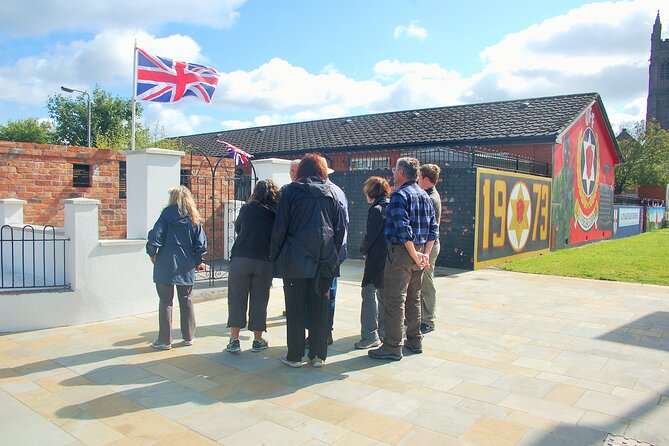
Next is Shankill Road, a predominantly working-class, unionist, and loyalist area. This stop brings you to political murals with historical connections to loyalist paramilitary organizations, specifically the Ulster Volunteer Force (UVF) and the Ulster Freedom Fighters (UFF).
If the Falls Road portion left you thinking about republican identity, Shankill Road balances the perspective. It’s not about taking sides on the ride. It’s about understanding how different communities recorded their own narratives through murals and symbols during the Troubles.
Your Shankill Road stop is also listed at about 25 minutes. That time allows for explanation of the murals’ political links and how they fit into the wider Northern Ireland conflict that ran from the late 1960s to 1998.
A useful way to approach this section is to treat it as a map lesson. The tour is showing you where conflict lines ran, how community identities formed along those lines, and how murals acted like public storytelling.
Potential drawback? If you come in expecting a single straight storyline, this is where you may realize the story has competing narratives. That can feel uncomfortable if you want simple answers. It can also be exactly what you need for a real understanding of Belfast.
Price and Value: Is $89.45 Worth It for a 1-Hour Ride?
At $89.45 per person for about 1 hour, this is not a bargain-basement attraction. But for what you get, it often feels like a fair exchange.
Here’s why the value can add up:
- It’s private, so you’re not sharing your taxi ride with strangers
- You get hotel pickup from most central Belfast locations
- The driver is local, and the storytelling is the point, not a bonus
- The vehicle is air-conditioned, which matters in a short, packed route
- A photo is included, so you don’t have to solve that logistics puzzle yourself
Also, because it’s only an hour, you’re paying for a focused introduction. If you’re trying to squeeze in key Belfast sights in limited time, a short guided ride can beat the hassle and uncertainty of figuring out the spots by yourself.
What’s not included is straightforward: drinks and food are not part of the price. Plan to eat before or after, especially because the tour is focused and you’ll likely want your attention on the conversation and the streets.
If you like your travel guided but not lecture-heavy, this style usually fits well. If you hate conflict topics, you should skip this. If you’re curious about how people remember hard times, you’ll likely find the price easier to justify.
Who Should Book This Tour, and Who Should Skip It
This tour is best for you if:
- You want a fast first look at Belfast murals and Troubles landmarks
- You prefer local, human stories from taxi drivers with real perspective
- You have limited time and want an organized loop across key neighborhoods
- You like photo stops but also want context so the pictures mean something
It’s less ideal if:
- You expect a neutral, purely scenic ride
- You want long stops at each location
- You do not want to engage with conflict history at street level
One quick note on family logistics. The tour info says children must be accompanied by an adult. It also says most travelers can participate. If you’re bringing kids, consider whether this subject matter fits your family’s comfort.
Practical Tips to Make the Most of Your Hour
First, dress for quick changes in weather. You’ll be outside around murals even if you’re mostly in the car, and you’ll want to be comfortable enough to look closely.
Second, bring a small mindset shift. Instead of trying to memorize everything, try to catch the themes. The murals and walls are doing repeat work: identity, memory, and boundaries.
Third, let your driver set the pace. Guides can tailor emphasis based on what you ask. That’s one reason the private format matters. You can steer the conversation without feeling like you’re stopping a schedule.
Finally, if you feel overwhelmed, it’s okay to take it in slower. Even a minute of silence near a mural can help the facts land the right way.
Should You Book This Belfast Taxi Tour?
I’d book it if you want one smart, organized hour that gives you a strong starting point for understanding Belfast’s Troubles era and the murals that still mark the city. The combination of a private black taxi ride, hotel pickup, air-conditioned comfort, and driver-led storytelling adds up to real value for the time you spend.
I would skip it if conflict history on the street sounds like too much, or if you’re only looking for scenery. This isn’t a casual stroll. It’s a story ride, and the story is heavy.
If you do book, go in ready to listen, look closely at the messages, and ask questions when you feel a connection to one topic. This tour is short, but it can steer your whole Belfast trip.
FAQ
How long is the Belfast taxi tour?
It runs for about 1 hour.
What is the price per person?
The price is listed as $89.45 per person.
Is the tour private?
Yes. It’s a private tour or activity, and only your group participates.
Where does the tour start?
The start point is the Leonardo Hotel Belfast on Great Victoria Street, Belfast (BT1 6DY). Pickup from most centrally located Belfast hotels is included.
Does it include a guide and transportation?
Yes. You get a guide and an air-conditioned vehicle. A photo is also included.
Is the tour offered in English?
Yes, it is offered in English.
Are drinks and food included?
No. Drinks and food are not included.
Is there an admission fee for the stops?
The tour information says ticket admission is free for the stops listed.
Can I bring children?
Children must be accompanied by an adult.
What if I need to cancel or change my booking?
This experience is non-refundable and cannot be changed for any reason. If it’s canceled because a minimum number of travelers is not met, you’ll be offered a different date or a full refund.
More Historical Tours in Belfast
- A History of Terror – Belfast City Centre Walking Tour
★ 5.0 · 2,883 reviews - Belfast Political/history/troubles private taxi/cab tour
★ 5.0 · 69 reviews - Belfast Walking Tour: City Centre History, Troubles & Stories
★ 5.0 · 39 reviews - Belfast political history and mural unique private 90 min tour
★ 5.0 · 10 reviews
Just added around Belfast
- Private Guided Walking Tour in Belfast★ 3.5 · 3 reviews
- Epic Escape Room Adventure to Save King’s Landing in Belfast★ 5.0 · 3 reviews
- Experience the Antrim Coast and the Land of Giants – Private Tour★ 5.0 · 3 reviews
- Game of Thrones scene location inc Giants causeway from Belfast★ 5.0 · 3 reviews
- Belfast to Dublin Transfer★ 5.0 · 3 reviews
- Giants Causeway Tour From Belfast including Game of thrones sites★ 5.0 · 3 reviews
- Private Coast Tour in Belfast★ 5.0 · 3 reviews
- Shore Excursion: Giants Causeway and Belfast City Tour★ 2.5 · 3 reviews