
Reviewed · THE TROUBLES HISTORY TOURS
IRA Troubles Conflict Private Tour Museum Graves Murals and Political Analysis
Belfast is one of those cities where history does not sit politely in museums. It’s painted on walls, built into barriers, and carved into memorial gardens. What makes this tour especially interesting is the way it strings together the Peace Walls plus the quieter places people mourn, not just the big photo spots. I especially love the private museum access and the chance to ask questions as you go, not during a rushed stop. The main drawback to consider is that this is explicitly guided from an Irish Republican perspective, so you will hear one side of the story more than the other.
You’ll ride in a car with the driver handling navigation, so you can actually look out the window and not miss what’s around the next corner. The guide style is a big part of why this tour gets praised, with standout guides including Barry, Joe, and Paula in the review notes. Expect a lot to pack into about three hours, because the route hits murals, memorials, and graves in quick succession.
Key highlights I’d build my day around
- Peace Walls up close, including a moment where you sign your name and write a message of peace
- Murals with political context, including the Falls Road, Shankill Road, and other interface-area artwork
- Private museum time, with a specific Irish Republican history museum and plans for what happens if it’s closed
- Milltown Cemetery and Bobby Sands sites, including the Republican plot marked with the Red Hand
- Hands-on details, including seeing and handling plastic and rubber bullets used by British Crown Forces
- A guide you can question, with guides drawing on long personal familiarity with Belfast life and the Troubles
What you’re really signing up for, Irish Republican Belfast, up close
This isn’t the kind of Belfast tour that tries to be a neutral highlight reel. You’re coming to understand The Troubles through an Irish Republican framing, from the early roots through the IRA era and into the current peace process. That viewpoint shapes everything: which murals matter most, which memorial plaques you stop for, and how the guide connects old events to what you can still see on the streets.
I like that the tour does not treat politics like trivia. It treats it like something people lived with, argued about, suffered from, and tried to shape into a different future. That’s why the Peace Walls do not feel like scenery here. They feel like an ongoing system that still affects movement and identity.
Keep in mind the trade-off. If you want a heavy focus on Loyalist arguments as an equal track, this tour is built more for Irish Republican history. The guide’s responses in the review notes point out that if you want both sides covered more evenly, there is a separate Belfast Taxi Tour option.
Other Troubles history tours, told plainly:
- Belfast’s Political Mural Taxi Tour
★ 5.0 · 1,180 reviews - Belfast Troubles Tour: Walls and Bridges
★ 5.0 · 853 reviews - Belfast Political Tour-Conflicting Stories Walking Tour
★ 4.5 · 459 reviews
3 hours of Belfast: why the pacing feels intense in a good way
The itinerary is designed around short, focused stops. Many locations are timed at 5 to 10 minutes, with a few longer visits for the heavier sites: the cemetery, the memorial garden, and museum time. That fast pace can feel like a lot, but it also keeps the day from turning into a slow bus tour.
You’ll see why this structure works when you hit the interface areas. Those neighborhoods are layered, and the guide uses each stop to explain cause and effect. In a short window, you get repeated “before and after” context: the wall, the mural, the memorial, the next wall.
The other practical win is transportation. The tour includes private transportation in an air-conditioned vehicle, with the driver handling navigation. In Belfast, where the interface areas are the point, being able to look out the window and not worry about routing makes the whole route easier to enjoy.
International Mural Wall on Divis Street and the Falls Road context you can’t miss
Your first big visual anchor is the International Mural Wall on Divis Street, with access to places not offered by every operator. The idea here is simple: get you to the Falls Road and then explain why this part of Belfast produced some of the most politically charged art of the era.
The guide delivers the story from the Irish Republican perspective, including how the conflict evolved for Republicans up to the present day and the peace process. Then the mural artwork becomes more than “cool street art.” Here, murals painted by ex-prisoners are treated as historical documents. You’re not just seeing paint, you’re seeing messaging.
You’ll also learn about Peace Walls as the physical divider that helped harden the city. The tour frames them as a key reason segregation became durable, starting with the onset of the Conflict in 1969 and how the walls fit into the shape of Belfast ever since.
What to watch for: the guide’s habit of tying a mural to a specific group, event, or decade. It’s the difference between taking photos and actually understanding what you photographed.
Peace Walls, Peace Gates, and the act of writing a message of peace
Peace Walls are central to this tour, and you see them more than once. The guided stop focuses on the peace lines separating predominantly Republican and Nationalist Catholic neighborhoods from predominantly Loyalist and Unionist Protestant neighborhoods.
Here’s the part I think you’ll remember: you visit both sides of the Peace Wall and you learn why the wall was built. Then you write your name and add a message of peace. That’s not just symbolic. It forces you to slow down and acknowledge the wall is not an old artifact, it’s a daily reality for the people living beside it.
You also get a “first hand” feel for how the communities are still divided, even with the peace process in place. The tour makes a strong argument that the walls were an effective solution to separation, and that effectiveness is part of why they never really disappeared. In the guide’s framing, many walls were constructed early, but about one third appeared after 1994 when the IRA declared an effective ceasefire.
Possible drawback for some people: if you prefer a lighter tone, memorial and conflict framing can feel heavy. This section is meant to land emotionally.
Other mural routes across the city:
- Famous 1.5 hour Belfast Murals Tour
★ 5.0 · 477 reviews - Belfast Murals Taxi Tour
★ 5.0 · 341 reviews - Private Political History & Murals Tour Belfast
★ 5.0 · 182 reviews - Giant’s Causeway and Belfast City Murals Tour inc Game of Thrones Dark Hedges
★ 4.0 · 180 reviews
Shankill Road murals and the Loyalist side of the interface picture
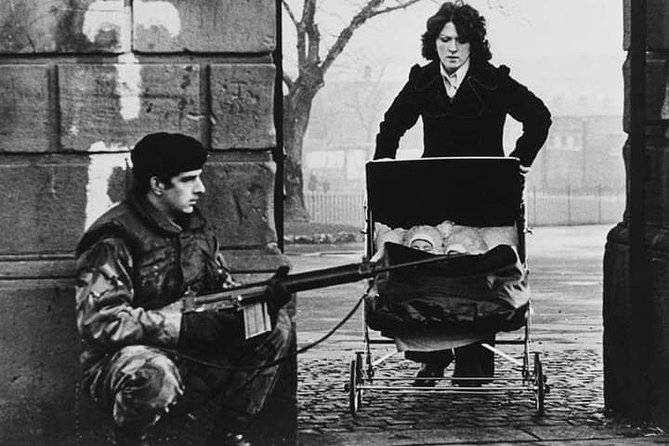
After the Falls Road context, the route crosses to Shankill Road, described as the heartland of Ulster Loyalism. You’re taken to see murals connected to Loyalist paramilitary groups, including UDA/UFF and UVF.
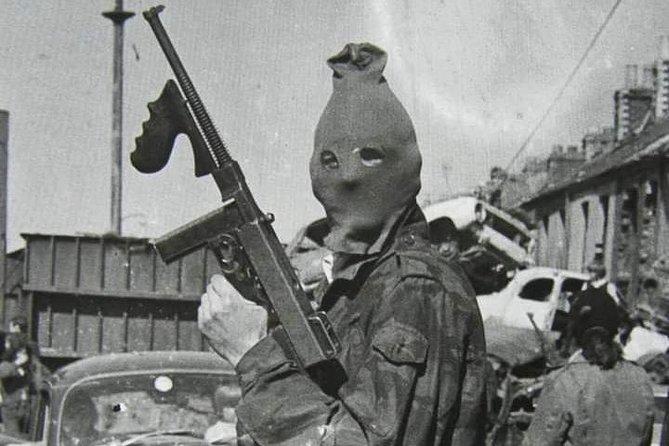
The murals you’ll photograph are described as masked men wielding weapons. The point of the stop is not just visuals. The guide explains how Loyalism developed and evolved and the role Loyalist organizations played during the conflict.
This is where the tour’s balance shows up in its own way. Even though the tour is guided from an Irish Republican perspective, it doesn’t avoid the Loyalist neighborhoods. It treats them as part of the system that produced violence and later segregation. That’s useful if you want to understand why Belfast hardened in the way it did.
Clonard Martyrs Memorial Garden: names, dates, and the weight of remembrance
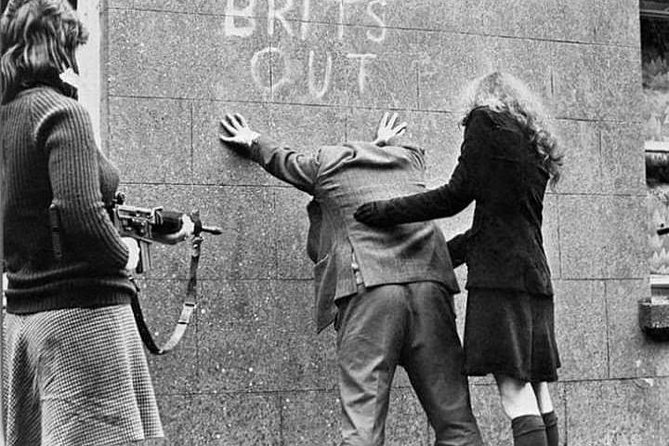
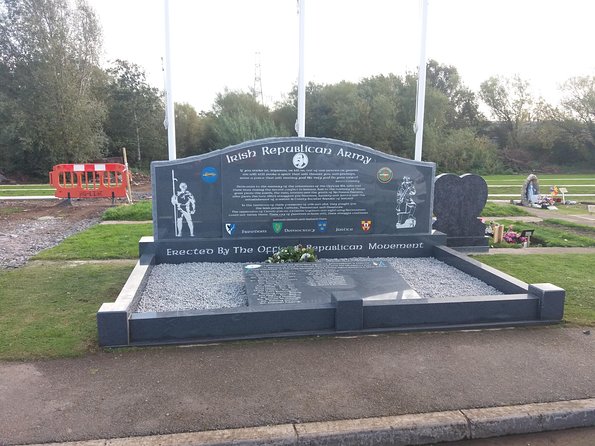
Clonard Martyrs is one of the most detailed stops in the entire route, and it’s not accidental. You visit the memorial garden at Bombay Street, Clonard, commemorating fallen volunteers of C Company, 2nd Battalion, Belfast Brigade, Oglaigh na hEireann, plus civilian casualties from the Greater Clonard area and deceased republican prisoners from that area covering 1916 to 1970.
This stop is different because it’s built around specific inscriptions and categories, not general statements. You’ll pass the iron gates and inscriptions connected to the Provisionals, plus the garden layout with separate yards. The central yard includes a black and white Celtic cross and plaques listing names and deaths by decade and period.
You’ll also see language of resistance and occupation, and you’ll understand that the memorial is designed to keep memory structured and repeatable, year after year. The annual commemorative march around 11 March is part of how that memory stays present.
Why it’s valuable: this is where the Troubles stop being a timeline and start becoming a record of people and losses tied to a neighborhood. It helps you see how local identity, political identity, and mourning overlap.
Milltown Cemetery Republican plot: Red Hand graves and Bobby Sands
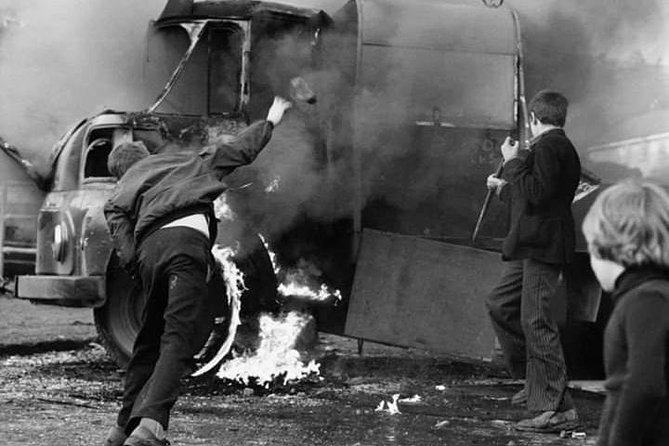
Milltown Cemetery is one of the most important sites on this tour, because you’re not only looking at murals. You’re visiting graves, including the Republican Plot where the Republican Patriot dead are buried.
A key theme here is that the graves are marked with the Red Hand. You also learn about the National Graves Association in Belfast and how the organization’s work includes republican plots and the graves of IRA volunteers killed during the 1920s and the Northern Campaign in the 1940s.
The stop highlights the best-known hunger striker in the tour, Robert Bobby Gerard Sands, a Provisional IRA member who died on hunger strike while imprisoned at HM Prison Maze. The tour ties his death to the 1981 hunger strike protest over removal of Special Category Status. There’s also a note that he was elected MP at the time of his death after 66 days.
If your only knowledge of Bobby Sands comes from headlines, this cemetery stop gives you a clearer sense of why his name has stayed in public memory.
If you’re short on emotional energy: build in time to just sit with it. The tour itself is quick, but the subject matter is not.
Bobby Sands murals, D Company Garden of Remembrance, and the hunger strike story in photos
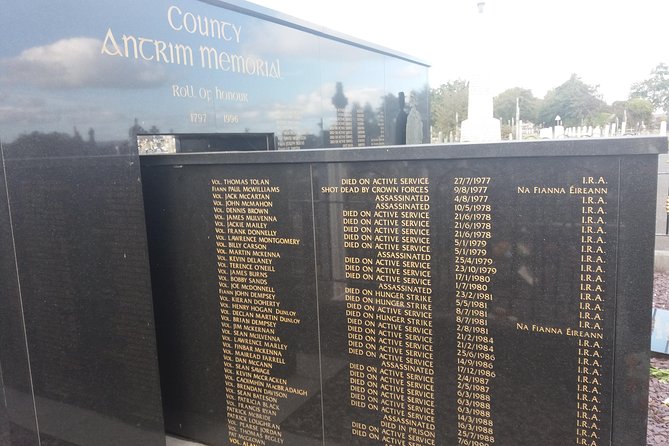
You’ll see Bobby Sands murals more than once, and you’ll also spend time at an IRA Garden of Remembrance known as D Company, 2nd Battalion IRA. The way the tour frames D Company here is as the Belfast Brigade’s second battalion focus, including the Falls Road, Clonard, and Ballymurphy district.
One stop emphasizes the Battle of the Falls (1970) and the Falls Road Massacre (1920). Another highlights the hunger strikes of 1981, including the blanket and dirty protests, and it notes that you can see photographs of hunger strikers, including 12 of the 22.
There’s a practical benefit to the repeated mural visits. One stop sets context and another gives you more time to photograph the iconic mural itself and connect it to the specific protests described by the guide.
Irish Republican History Museum: meeting ex-prisoners of war, plus the Eileen Hickey name
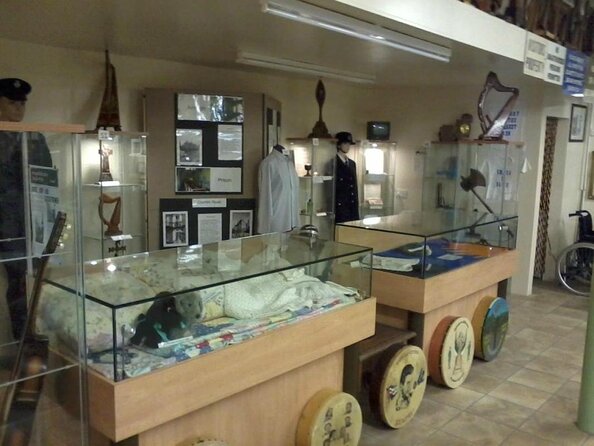
This is the part people seem to love most: the tour includes an Irish Republican History Museum, described as Eileen Hickey Irish Republican History Museum. The museum is presented as a place where you learn about resistance against British occupation and the struggle over the last 800 years in Ireland.
The tour notes a real human element too. You meet ex-prisoners of war who share their experiences of the Conflict. That’s a big deal for a Belfast visit because it shifts the tone from “facts on a page” to “memory from a life.”
There’s also a clear timing detail you should respect. The museum only opens 10-2 Tuesday to Saturday. If it’s closed, the tour plan is to show you around Ballymurphy instead.
Clonard Monastery: where peace work and frontline Belfast geography meet
Clonard Monastery is a Catholic church and monastery off the Falls Road, home to the Redemptorists. The tour frames Clonard as being on the front-line of the Troubles that erupted in Belfast in 1969.
The stop is tightly connected to neighborhood geography. The rear of the monastery was linked to Bombay Street and Cupar Street, which led on toward the Shankill Road. On 14 August 1969, the tour describes loyalist mobs from the Shankill Road launching attacks on houses in those streets, forcing residents to flee and burning buildings, including whole parts of Bombay Street.
Priests from Clonard are described as being actively involved from the outset in safeguarding local residents. The tour also points to two Northern Ireland clergy tied to peace work, Frs. Alec Reid and Gerry Reynolds.
Why this stop matters: it shows that interface areas were not only about militias and murals. They were also about everyday protection, faith, and attempts to reduce harm.
Divis Tower, Divis, and the Welcome Wall: snipers nest history and names you can see
Later in the route you reach Divis Tower, described as overlooking the Falls Republican stronghold. The tour explains that the British Army had a snipers nest and spy post there until 2005.
You’ll also see names and murals of the first two victims of the Troubles. That detail matters because it pulls the conflict back to early stages, not only later years when many people think the story “starts.”
Then you pass the Welcome Wall in Divis, described as the heartland of the Irish Republican Army. You also drive by a Peace Wall again, described as the biggest peace wall in Belfast.
This is a good reminder that Belfast’s “visual map” is political. Even when you are not stopping, walls and murals are still doing the work of telling you what belonged where.
Ballymurphy Road: An Gorta Mor, local volunteers, and Jim Bryson’s machine gun mural
Ballymurphy is a quick ride-through stop that focuses on murals. You’ll see the murals to An Gorta Mor and then drive through streets of Republican Ballymurphy with murals connected to local volunteers.
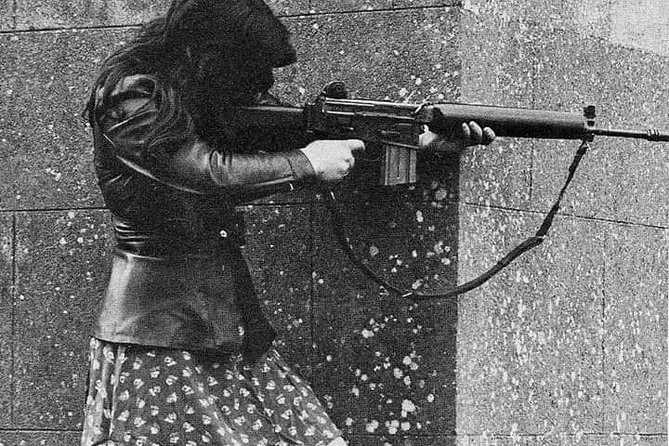
One highlighted mural is Jim Bryson and his Big Louie machine gun, described as used to terrify the British Army. The wording is blunt, and that bluntness is part of what makes this tour different from a generic “history bus.”
If you’re wondering why a drive-by stop counts: in Belfast, murals mark territory, memory, and identity. The guide treats them as evidence. So even short sightings can be meaningful.
Hands-on details and what this means for your understanding
This tour includes a rare sort of add-on detail: you get to see and handle plastic and rubber bullets used by British Crown Forces. That’s not a typical city sightseeing element. It turns the conflict from something abstract into something physical.
It also reinforces why the tour emphasizes memorial gardens, graves, and museum encounters. You’re not only hearing political analysis. You’re encountering the materials and objects that represent how the conflict played out on the ground.
Also worth noting: several stops include admission ticket time, and Stop 12 Ballymurphy Road is free. So the itinerary is built to include paid access moments rather than only curbside viewing.
Price and value: is $255.50 per person worth it?
At about $255.50 per person for roughly three hours, you’re paying for three things at once.
First, you get private transportation in an air-conditioned vehicle with round-trip transfers handled by the operator setup. Second, you get access that is described as private museum access and other locations not offered by every competitor. Third, you’re paying for a guide-led explanation from an Irish Republican perspective, with room for questions.
The review scores help you understand how those elements land. The rating is 4.9 with 67 reviews, and 97% of reviewers recommend it. The strongest praise in the notes centers on being extremely thorough, eye-opening, and emotionally moving, with guides like Barry and Paula singled out for personal lived-experience context and the ability to answer questions.
Who gets the best value: people who want more than a highlights loop, and who are willing to engage with the heavy political and human side of Belfast history.
Should you book this tour?
Book it if you want a structured, guide-led Belfast route that connects murals, Peace Walls, memorial gardens, and graves into one clear story. You’ll get especially strong value if you care about the Irish Republican perspective, and if you’re curious enough to sit through museum and cemetery stops.
Skip it or pair it with a different style of tour if you want a more even split of Loyalist argumentation. The tour is built around Irish Republican narration, and the review notes include at least one complaint about missing Loyalist viewpoints, paired with the operator’s suggestion to seek their balanced Belfast Taxi Tour for both sides.
If your schedule is tight, remember the museum hours detail: the Irish Republican History Museum opens 10-2 Tuesday to Saturday, and the plan is Ballymurphy if it’s closed.
FAQ
How long is the tour?
It runs for about 3 hours.
Is this a private tour, and is it offered in English?
Yes, it is a private tour with only your group participating, and it is offered in English.
What happens at the Peace Wall stop?
You visit both sides of the Peace Wall, learn why the wall was built, and sign your name and write a message of peace.
Does the tour include Milltown Cemetery and Bobby Sands-related sites?
Yes. You visit Milltown Cemetery, including the Republican plot and Bobby Sands resting place. You also visit Bobby Sands murals.
Does the tour include the Irish Republican History Museum?
Yes. The Irish Republican History Museum is included, and it only opens 10-2 Tuesday to Saturday. If it is closed, the plan is to show you around Ballymurphy.
Are admissions and tickets included?
The itinerary notes admission ticket included for multiple stops, and the tour also includes access to the sites listed in the Included section.
Is there anything hands-on during the tour?
Yes. The tour includes seeing and handling plastic and rubber bullets used by British Crown Forces.
Where is pickup, and can I cancel for free?
Free pickup is offered from the central meeting location at the Leonardo hotel. Other pickup locations have extra charges, and you can cancel for a full refund if you cancel at least 24 hours in advance.
More Museums in Belfast
- Titanic Museum and Whiskey Distillery Exploration with Tasting
★ 4.5 · 25 reviews - Belfast City Sightseeing Tour Including Titanic Museum | 6 Hours
★ 4.5 · 9 reviews - Peacemakers Museum Entry Ticket
★ 5.0 · 37 reviews
Just added around Belfast
- Private Guided Walking Tour in Belfast★ 3.5 · 3 reviews
- Epic Escape Room Adventure to Save King’s Landing in Belfast★ 5.0 · 3 reviews
- Experience the Antrim Coast and the Land of Giants – Private Tour★ 5.0 · 3 reviews
- Game of Thrones scene location inc Giants causeway from Belfast★ 5.0 · 3 reviews
- Private Coast Tour in Belfast★ 5.0 · 3 reviews
- Belfast to Dublin Transfer★ 5.0 · 3 reviews
- Giants Causeway Tour From Belfast including Game of thrones sites★ 5.0 · 3 reviews
- Shore Excursion: Giants Causeway and Belfast City Tour★ 2.5 · 3 reviews