
Reviewed · HISTORICAL TOURS
This is Belfast Walking Tours. Our history, our culture.
Belfast has a talent for hiding big stories in plain sight, and this walking tour keeps that theme front and center, starting at the Big Fish and ending at Belfast City Hall. I like that the stops connect city identity to real places, so the tour feels like it explains Belfast, not just points at it. I also like how the route moves through religion, politics, industry, and music in a tight 2 to 3 hours.
One thing to consider is pacing and expectations: you will be walking and listening outdoors most of the time. And there is at least one stop where the admission is not included, so if you want to go inside, you may need to pay separately for that portion.
If you prefer a small group, you will be in good shape. The tour caps at 15 travelers, and it runs in English with a mobile ticket, which makes it easy to roll in and get started.
Key highlights to watch for
- Big Fish, Farset, and the Salmon of Knowledge legend tied to Belfast’s river and shipbuilding roots
- Customs House switching roles from commerce to a summer music amphitheatre
- Prince Albert’s memorial clock and the clock tower’s hidden story
- Joy’s Entry and Henry Joy McCracken, a key name in 1798 United Irishmen rebellion
- Cathedral Quarter transformation, including punk-era Belfast references
- Belfast City Hall and the Titanic Memorial Garden as a quiet, reflective finish
Start at the Big Fish, and let the river explain the city
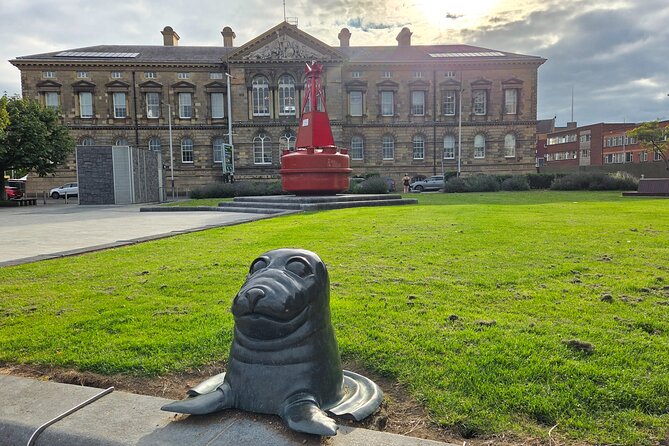
Your tour kicks off at the Big Fish on Donegall Quay, Belfast BT1 3NG. Locals know it as the Salmon of Knowledge, and the story is more than a cute nickname. The fish’s scales are treated like a map of Belfast and its people, with links to the River Lagan, shipbuilding, and Belfast Lough.
Then there is the detail that makes the whole walk click: underneath the Big Fish is a hidden river, called the Farset, which gives the city its name. That one idea helps you read Belfast differently as you move away from the waterfront. You start noticing how waterways shaped trade, where industry took hold, and why certain parts of the city grew into major centers.
This is a smart first stop because it sets the baseline for the rest of the route. You get the local story engine running, so later stops feel connected instead of random.
A few more Belfast options side by side
- A History of Terror – Belfast City Centre Walking Tour
★ 5.0 · 2,883 reviews - Private Political History & Murals Tour Belfast
★ 5.0 · 182 reviews - Belfast Political/history/troubles private taxi/cab tour
★ 5.0 · 69 reviews
Customs House: from industry power to a summer music stage
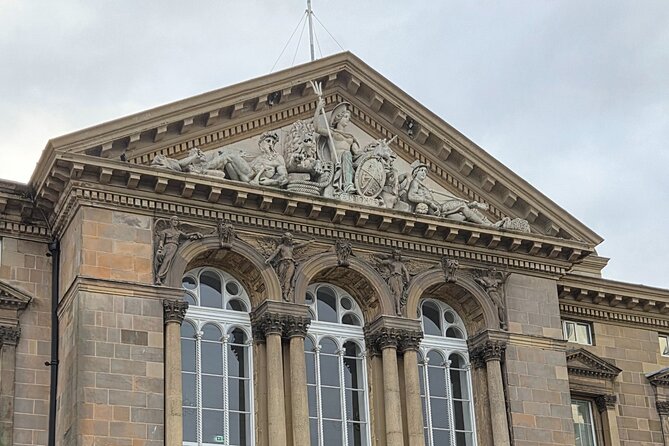
Next up is the Customs House. The tour frames it as Belfast punching above its weight in the industrial revolution and in commerce. In other words, this building is not just architecture. It is a symbol of how Belfast turned shipping and trade into economic momentum.
What I like here is the contrast. You hear how Customs House once served as a gathering place for public meetings, then how it later became a fantastic amphitheatre for summer music. That matters because it shows the city’s shift from heavy industry and business to public culture you can actually enjoy.
In practical terms, this stop is short, around 10 minutes. You will not get a long lecture. You will get enough context to understand why the area matters, and then you move on while the story stays fresh.
Albert Memorial Clock Tower: the memorial clock with a secret
From there, you head to the Albert Memorial Clock Tower. It is a major Belfast landmark, built after the death of Prince Albert, beloved husband of Queen Victoria. The tour also teases a Big Secret of the clock, which is the kind of detail that makes you look up and notice what you might otherwise ignore.
This stop is about 10 minutes, so it is not a sit-and-stare photo break. Instead, it is a quick moment to connect monarchy, mourning, and civic identity, all wrapped into one tower that still anchors the streets.
If you enjoy spotting how “official” monuments land in everyday life, you will appreciate this stop. If you want deep indoor museum time, this tour is not that kind of experience. It is built for seeing the city and hearing stories you can carry with you.
Joy’s Entry: High Street roots and Henry Joy McCracken
The walking part takes you to Joy’s Entry, tied to the birthplace of the city on Belfast High Street. Here the focus turns to revolution and the people behind it.
You will hear the story of Henry Joy McCracken, described as a Presbyterian leader of the United Irishmen Rebellion of 1798, and the tour connects that legacy to what this street area became later. This is one of those stops where a small space can hold a lot of meaning, because city entries and street lines are often where old power struggles still echo.
I like that the tour does not keep everything in the distant past. It treats the city as a living system where political ideas, religious communities, and street-level life were closely linked. That makes Belfast feel more human and less like a list of monuments.
A different sort of day out of Belfast:
- Titanic Belfast Entrance Ticket: Titanic Visitor Experience Including SS Nomadic
★ 4.5 · 3,698 reviews - Cab Tours Belfast Famous Black Taxi Tours
★ 5.0 · 3,633 reviews - Giant’s Causeway Day Trip from Belfast
★ 5.0 · 3,480 reviews - Game of Thrones and Giant’s Causeway Full-Day Tour from Belfast
★ 5.0 · 2,291 reviews
First Presbyterian Church: a brave stand tied to social issues
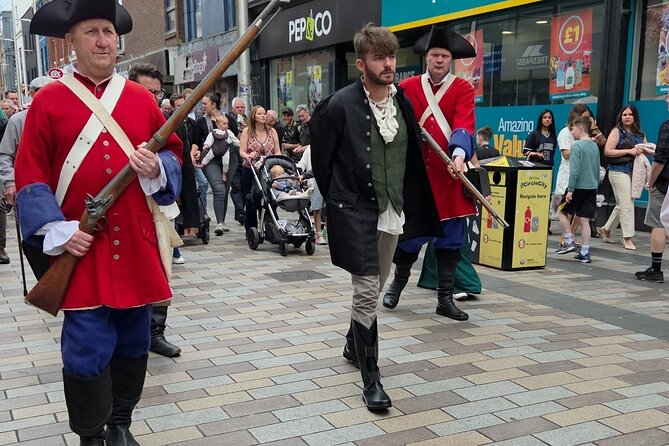
Then comes the First Presbyterian Church, in the heartland of Presbyterian Belfast. The tour frames it around forward-thinking radicals and the development of Belfast commercially and socially.
There is also a strong moral note here. You hear about the brave stand by one Presbyterian against slavery. The details may not be long, because the stop is about 10 minutes, but the point lands. It connects a local church setting to an issue that reached far beyond Belfast.
One practical consideration: admission here is not included. So if you want to go beyond what you see from the outside, plan on the possibility of paying separately. In general, bring a respectful attitude. Churches are working religious spaces, even when they also serve as heritage sites.
If you prefer your history with a social conscience, this is the stop that gives you that angle.
Cathedral Quarter: punk origins, pub culture, and the Cathedral
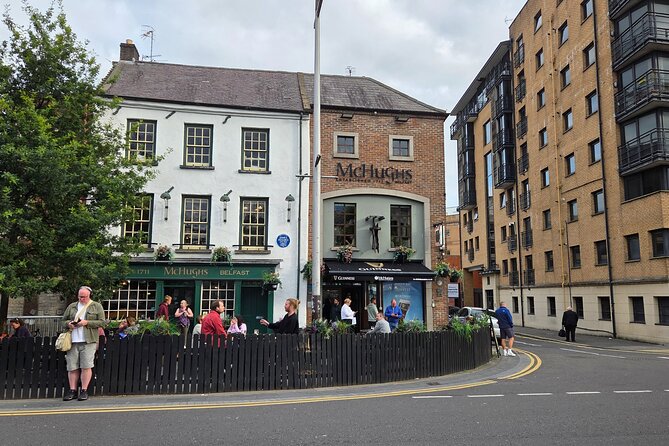
Next you move into the Cathedral Quarter, which the tour describes as a shift from rundown, forgotten parts of the city to Belfast’s food and entertainment hub. This section is one of the most fun because you get a sense of what the city feels like now, not just what it was.
You get specific cultural anchors, including references to the origins of Belfast punk music. There is also a named stop area linked to the Duke of York pub and the Merchant Hotel, which helps you picture what you are walking past rather than guessing.
Then the tour brings you toward the Cathedral itself, described as stunning and historic. You get another quick “place in context” moment, with about 15 minutes here.
What I like is that Cathedral Quarter ties together a city’s creative identity and its long-standing buildings. You can almost see how old Belfast and new Belfast share the same streets, just with different energy.
If you want to snack or grab a drink afterward, this is a good area to do that. The tour ends up in the right neighborhood for it.
Royal Avenue: Victorian power and the look of economic ambition
Royal Avenue is where the tour leans into Victorian grandeur. The stories here are symbolic of Belfast as a world economic powerhouse, so the focus is on how the city presented itself, not just what it produced.
You walk past the kind of street scale that makes you understand why cities compete. When people invest in major buildings, it is also a signal of confidence and status. This stop is about 15 minutes, so you get enough time to take in the street character and connect it to the broader Belfast story you have been building since the Big Fish.
If you love urban design, this stop helps you read Belfast like a map of ambition, including which periods left the strongest visual mark.
Belfast City Hall: civic drama, the Troubles, and Titanic Memorial quiet
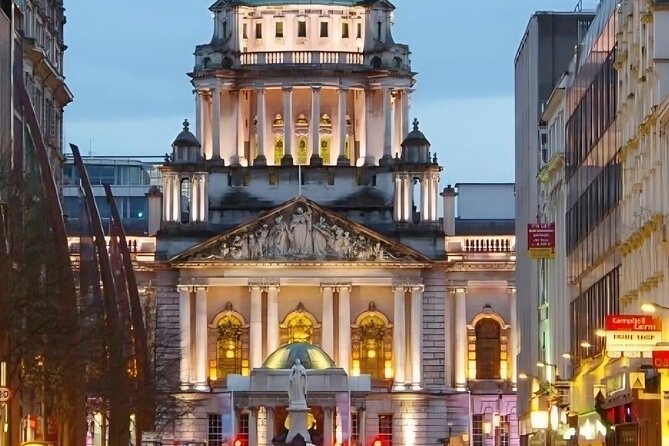
The final major stop is Belfast City Hall, the tour describes it as the jewel in the centre of the city. This is the focal point for protests, meetings, commemoration, and celebration.
This is also where the tour acknowledges the Troubles, with the idea that City Hall bore the story of those years and also a positive future. That combination matters. It prevents the tour from becoming either purely celebratory or purely heavy. You get a civic building with layers.
And you finish in a quieter direction: the Titanic Memorial, with the Titanic Memorial Garden as the ending point. It is a reflective close that changes the emotional tone from street-level stories to a slower, more respectful pause.
The walk ends at City Hall grounds, Belfast BT1 5GS. For your last photos, I suggest you take a moment at the garden finish point rather than rushing straight out. This ending style is one reason the tour works so well if you want a complete first-pass Belfast experience.
How long it takes, and what the walking feels like
The tour runs 2 to 3 hours, with stops that are usually around 10 to 15 minutes each. That structure is ideal if you like “just enough time” at each place. You are not stuck at a single attraction waiting for a long pause. You keep moving, and the stories keep coming.
It is also the kind of pace that suits a wide range of travelers. Most people can participate, and the route is in central Belfast with a near-public-transportation setup. That means you can plug it into a day plan without needing a dedicated half-day.
If you are the type who loves long museum interiors, this is not the format for that. Think of it as a streets-and-stories tour. You will remember it because it teaches you how Belfast connects itself: river to industry, politics to buildings, music to neighbourhood change.
Value for money: why $27.15 makes sense here
At $27.15 per person, this tour sits in the “good value for a guided orientation” category. You get multiple city center landmarks, a tight narrative thread linking Belfast’s economy, politics, and culture, and a small group cap that helps the experience feel personal.
There is also a practical cost angle built into the stop descriptions. Most of the sights have admission tickets that are free within the tour stops. The one exception called out is the First Presbyterian Church admission being not included. That means you will likely only need extra money if you choose to go inside there.
Add the mobile ticket convenience, and it becomes a low-friction way to get a guided baseline. You are paying for interpretation, not just walking around. In Belfast’s city center, that kind of guidance can save you hours of independent guessing.
Who this Belfast walking tour is best for
You should strongly consider this tour if you:
- Want an easy way to get oriented in Belfast’s core within a short time window
- Like stories that connect politics, religion, industry, and music to real locations
- Prefer small-group walking tours rather than large bus groups
- Plan to explore on your own right after, and want context to guide what you do next
It is also a good choice for a first time visit because the route hits major central touchpoints. And if you are traveling with a service animal, service animals are allowed.
If you are very sensitive to walking outdoors, plan your timing with weather in mind. This is not an indoor-only tour, and the stops are short, so you cannot rely on long sheltered breaks.
Should you book Belfast Walking Tours, Our history, our culture?
Yes, I would book it if your goal is to understand Belfast fast and enjoy the city while you do it. The route starts at the Big Fish, then moves through Customs House, the Albert Memorial Clock Tower, Joy’s Entry, and the Cathedral Quarter before finishing with City Hall and the Titanic Memorial Garden. That is a well-chosen spine of stops for making the city feel coherent.
I would not book it if you only want one theme, like purely military history or purely entertainment. This tour spreads across several big threads, so the payoff is in connections, not in deep focus on one topic.
For most people, it is an efficient and genuinely enjoyable way to see Belfast’s past and present stitched together on foot.
FAQ
How long is the Belfast walking tour?
It runs about 2 to 3 hours.
Where does the tour start and where does it end?
It starts at the Big Fish, Donegall Quay, Belfast BT1 3NG, UK, and it ends at Belfast City Hall, Belfast BT1 5GS, UK.
How much does it cost?
The price is $27.15 per person.
Is the tour in English?
Yes, the tour is offered in English.
Do I need a printed ticket?
No. It uses a mobile ticket.
Is cancellation free?
Yes, you can cancel for free up to 24 hours in advance for a full refund. If you cancel less than 24 hours before the experience starts, the amount paid is not refunded.
Just added around Belfast
- Private Guided Walking Tour in Belfast★ 3.5 · 3 reviews
- Epic Escape Room Adventure to Save King’s Landing in Belfast★ 5.0 · 3 reviews
- Game of Thrones scene location inc Giants causeway from Belfast★ 5.0 · 3 reviews
- Experience the Antrim Coast and the Land of Giants – Private Tour★ 5.0 · 3 reviews
- Private Coast Tour in Belfast★ 5.0 · 3 reviews
- Belfast to Dublin Transfer★ 5.0 · 3 reviews
- Giants Causeway Tour From Belfast including Game of thrones sites★ 5.0 · 3 reviews
- Giants Causeway Private Tour★ 5.0 · 3 reviews