Reviewed · PRIVATE
Private Belfast Explore Like a Local
Belfast can look like a regular city until you start walking and listening. This private tour connects the dots, from Victorian landmarks to the murals and peace lines that explain the Troubles without turning it into a textbook. I especially love how it keeps the pace easy, with pickup and a driver who handles routes, and how the stops include both the iconic sights and the real local context.
Two things I also like a lot: the Belfast murals and political street art are shown up close in the neighborhoods where they matter, and the itinerary mixes Belfast’s big public landmarks with quieter places that help you understand why people remember what they remember. The one drawback to consider is that the story of the Troubles can be emotional and political, and your guide’s tone may not feel perfectly balanced to everyone, so it helps to be clear about what you want from the experience.
Key things I’d watch for before you go
- Private, flexible format with hotel pickup and drop-off from central Belfast
- A strong Troubles-and-murals focus with stops tied to Bobby Sands, hunger strikes, and peace lines
- Botanic Gardens and Queen’s Quarter added for a smooth “Belfast beyond the murals” start
- Titanic Quarter photo stops that work well if you are curious but not trying to buy every ticket
- Included Peace Line and Peace Wall experience with the sign-your-name message of peace and hope
Victorian Gardens to Queen’s Quarter: starting Belfast the easy way
Most people land in Belfast and try to cram everything into one day. This tour starts with the opposite approach, you get dropped into the heart of the city’s old elegance first, then you move into the places where Belfast’s modern identity was shaped.
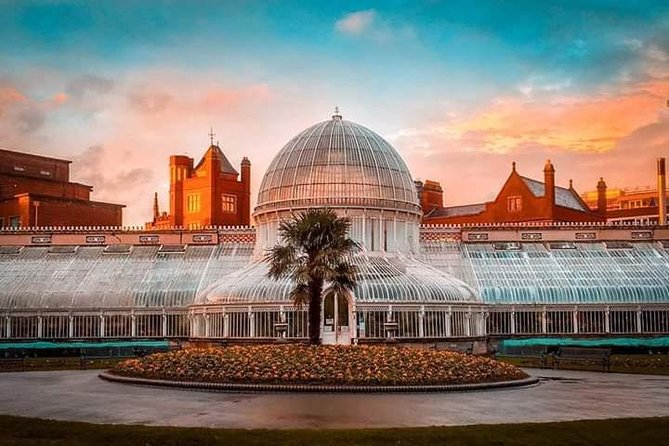
The opening stop is the Botanic Gardens, a 28-acre park dating back to 1828. It was created after public interest in horticulture and botany, and it still feels like a meeting point for students, office workers, and visitors. If you like architecture and plants, you’ll notice the park’s famous glasshouses, including the Palm House, built with cast iron and glass. It’s the kind of landmark you can’t really recreate from photos.
Then you head to Queen’s University Belfast in the Queen’s Quarter. The university was chartered in 1845 and opened in 1849 as Queen’s College, Belfast. Even if you are not a campus person, it helps to see how this area became one of Belfast’s cultural districts, because it’s right next to other major institutions and museums.
What I like about starting here is that you’re learning Belfast’s “everyday spine” before you hit the more heavy sites. You also get a sense of how Belfast developed as a modern city, not just a place defined by conflict.
Practical note: this isn’t a slow garden walk with hours to wander. Expect a guided look with just enough time to orient yourself and get photos.
More days out of Belfast:
- Titanic Belfast Entrance Ticket: Titanic Visitor Experience Including SS Nomadic
★ 4.5 · 3,698 reviews - Cab Tours Belfast Famous Black Taxi Tours
★ 5.0 · 3,633 reviews - Giant’s Causeway Day Trip from Belfast
★ 5.0 · 3,480 reviews
RISE sculpture and Divis Tower: Belfast’s skyline with a memory attached
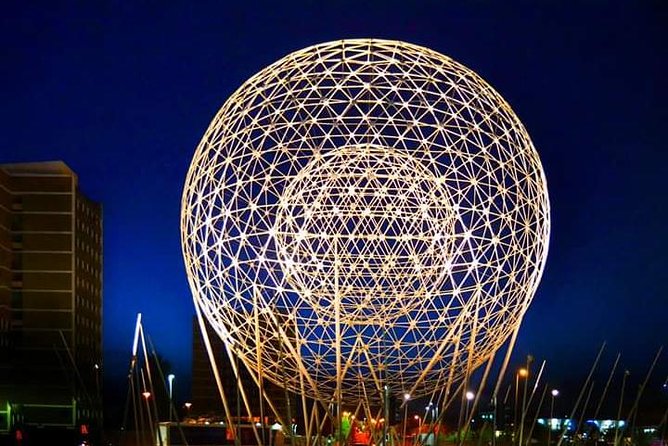
After the gardens and university, the route shifts to public space and city gateways. You’ll stop for RISE, the spherical metal sculpture by Wolfgang Buttress, often nicknamed The Balls on the Falls. It was built around 2011 and towers over the Broadway roundabout where heavy traffic funnels into Belfast. It’s hard to ignore because it’s literally designed to be visible for miles.
From there, the tour moves into Divis Tower, near the interface between Falls Road and Shankill Road. This stop is where the scenery starts carrying weight. Divis Tower was built in 1966 as part of the Divis Flats complex and became home to thousands of residents. It also sits on a site that used to have a Falls Road Methodist Church, which opened in 1854 and closed in 1966.
The key point for you here is that Divis Tower isn’t just a tall building. It’s tied to specific events from the Troubles, including an Army observation post on the roof in the 1970s. The story includes the killing of nine-year-old Patrick Rooney in August 1969 and the later killing of Emmanuel McClarnon by an Army sniper in 1981. Those details can hit hard, so if you want to mentally pace yourself, tell your guide and take a breath before the next stop.
If you are hoping for neutral, emotionally light commentary, this is not that. But if you want to understand why Belfast looks the way it does and why some places stay charged in people’s minds, this stop earns its place.
Peace lines and the “message of peace” moment
Next comes the part that many first-time Belfast visitors hear about but don’t fully grasp until they stand close. The tour includes time at the Peace Walls and Peace Line interface areas. These walls are built to separate predominantly Catholic neighborhoods from predominantly Protestant neighborhoods, and they can include gates that are locked at night.
The big idea you should carry with you: these aren’t just monuments. They affect daily routes, daily feelings, and daily chances for people to move freely. In Belfast, the walls became more common and more permanent after the conflict erupted in 1969, and they multiplied over time.
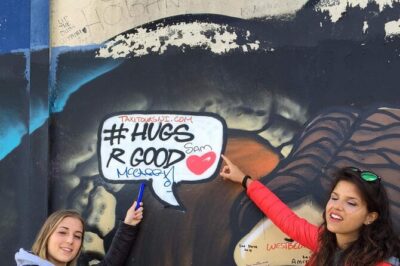
What I like is that the tour does not stop at showing the wall. It includes a chance to sign your name and leave a message of peace and hope connected to the Peace Line and Peace Wall experience. That matters because it turns you from a spectator into someone acknowledging the human side of the story.
Timing tip: these stops can feel short on paper, but they are often the most intense parts of the day. If your schedule allows, bring patience. You will likely want a moment to take in what’s right in front of you before you push on.
St Peter’s Cathedral and Clonard Martyrs: faith, community, and memory
From the interface barriers, the tour shifts to religious and community sites that show how local life continued through upheaval. St Peter’s Cathedral sits on the Divis Street area on the Falls Road. Construction began in the 1860s, it opened in 1866, and the signature twin spires were added in 1886.
You’ll learn it originally began as a parish church for Belfast’s expanding post-Famine Catholic population, and that the design involved Fr Jeremiah Ryan McAuley. The building is made of Scrabo sandstone with Scottish sandstone dressings, and inside you’ll find a hammer-beam ceiling.
Then you head to Clonard Martyrs, a memorial garden tied to the Provisional IRA era beginning in 1969. The site includes black iron gates with a phoenix motif, and it’s organized into three yards with cross imagery and memorial plaques. The memorial language explicitly notes fallen volunteers, civilians killed in the Greater Clonard area, and republican prisoners connected to that area.
This is not a place for quick sightseeing. It’s a place where the tone of your guide matters, and where you should be honest with yourself about what you can emotionally handle in one sitting.
A few more Belfast options side by side
- Private Black Taxi Belfast City Tour
★ 5.0 · 2,188 reviews - 2 Hour Private Belfast Taxi Cab Tour of Troubles & Peace walls
★ 5.0 · 240 reviews - Private Political History & Murals Tour Belfast
★ 5.0 · 182 reviews - Giants Causeway & Antrim Coast Private Tour
★ 5.0 · 176 reviews
Murals on the Falls Road and beyond, plus a Shankill contrast
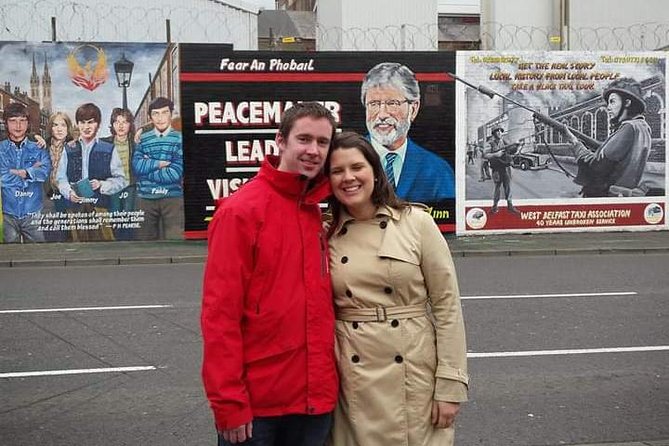
One of the most praised parts of this tour is the way it handles murals. You’ll visit the Bobby Sands mural, where you’ll learn about Sands and the 1981 hunger strike. The mural’s design elements include symbols like the phoenix rising and chain imagery, and you’ll also hear about the political meaning behind the details.
Next, you’ll visit Shankill Road, the heartland of Ulster loyalism. It’s a working-class area in West Belfast, and the tour frames it as a contrast to the Falls Road side of the city. The road stretches about 2.4 km, with shops along parts of it and residential streets branching away.
You should know that the Shankill area has been associated with different paramilitary groups, which is part of why some people are cautious about how they talk about it. Your guide can help you understand the landscape without you having to guess.
Later in the day, the tour includes additional mural stops and related street art, including an International Mural Wall Divis Street area where you may even see a Donald Trump mural. Belfast and Derry are known for political street art, with hundreds documented since the 1970s. This kind of art works like a language for communities, and it’s one reason Belfast feels so readable once someone explains the context.
Small caution: murals can be personal. If you are sensitive to violent symbolism or specific political messaging, let your guide know so the route can feel more comfortable.
Belfast Castle and Queen’s Square: city pride on higher ground
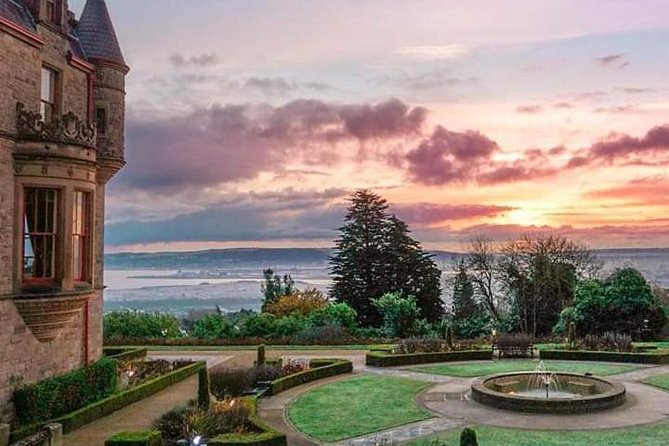
After the heavier stops, the itinerary swings toward classic Belfast landmarks. You’ll visit Belfast Castle, perched above the city on the slopes of Cavehill Country Park. The views are part of why the castle is special, you get a wide look over Belfast and Belfast Lough.
The castle itself has an odd and charming side. It includes the famous Cat Garden, with nine cat sculptures and mosaic work tied to the local legend about a midnight cat. If that’s your kind of detail, it’s a nice reset after wall and mural intensity.
One thing to note: the tour’s Belfast Castle stop lists admission ticket not included. So if you want to go inside, you may need to plan separately.
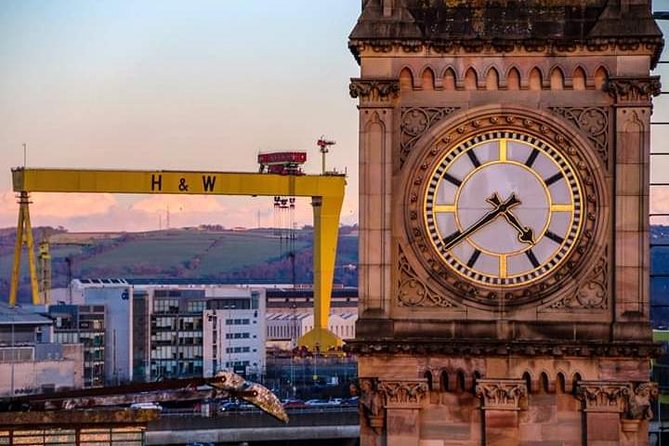
Then you move to Albert Memorial Clock Tower in Queen’s Square, a well-known landmark completed in 1869. It was built in a Gothic mix of styles, includes flying buttresses, and it leans due to construction on wooden piles on marshy land around the River Farset.
The clock tower story also includes social history, like how the area around it was once notorious for prostitution frequented by visiting sailors. In more recent decades, the nearby public spaces have been regenerated, which helps explain why this landmark feels like both memory and everyday city life.
From the Lagan to Titanic Quarter: the industrial story with a storybook name
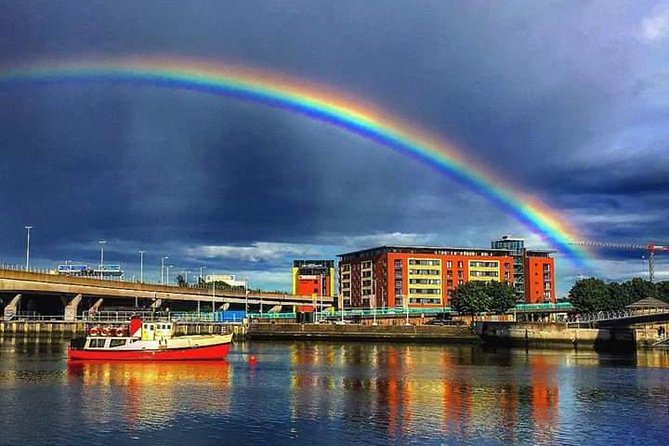
Next the tour shifts from monuments to waterfront identity. You’ll stop at the Big Fish, the Salmon of Knowledge mosaic sculpture on Donegall Quay near the Lagan Lookout. Each tile scale carries text and images about Belfast’s history, and there’s even a time capsule inside the artwork. It’s artsy, but it’s also a clever way to teach without lecturing.
After that you’ll see Samson and Goliath, the twin shipyard gantry cranes at Queen’s Island. These cranes dominate the skyline and became a symbol for Belfast, and they were built in the Harland and Wolff shipyard by Krupp, with Goliath finished in 1969 and Samson in 1974. Important correction for expectations: they were not built for Titanic, since they were constructed long after.
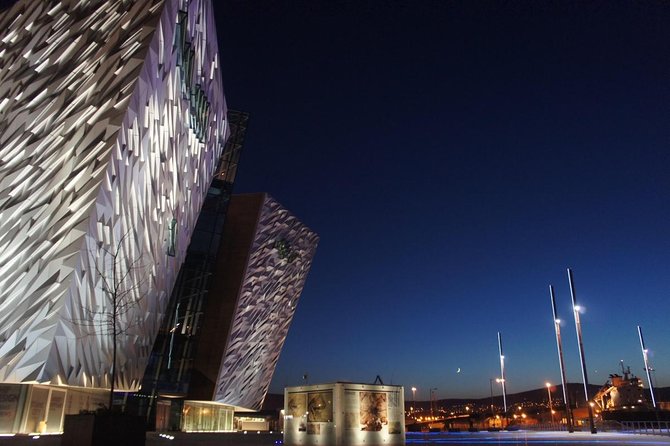
You’ll also get photo opportunities at SS Nomadic in the Titanic Quarter. It’s a former White Star Line tender launched in 1911 in Belfast, and it is the only White Star vessel still in existence today. The tour also includes a photo stop at Titanic Belfast, located on land at Belfast Harbour in the Titanic Quarter regeneration area.
Both SS Nomadic and Titanic Belfast are listed as admission ticket not included on this tour. That’s not a dealbreaker, but it does mean you should decide ahead of time whether you want to pay extra to go inside those specific attractions.
If you’re the type who wants the emotional behind-the-scenes side, the waterfront stops will work well as a visual bridge, tying Belfast’s industrial era to the globally recognized Titanic story.
Crown Liquor Saloon and a city look at wealth addresses
To end on a more human, warm note, the tour finishes at the Crown Liquor Saloon. It’s a famous Victorian gin palace pub, refurbished in 1885 and known as one of Northern Ireland’s best-known pubs. The stop is listed with admission ticket included, and it’s a natural place to grab a drink and decompress.
The itinerary then includes a brief look at BT9 6RU, described as an affluent area with large mansions. This isn’t a typical sightseeing stop, but it does help you round out what Belfast looks like across different class lines.
Then it circles back to West Belfast mural territory again, plus a visit to Clonard Monastery and an International Mural Wall Divis Street stop. Clonard Monastery is a Catholic church and monastery connected to the Redemptorists, and it’s known for having sheltered people from the nearby Shankill area during the Belfast Blitz when over 300 Protestants hid in the crypt.
That detail is worth holding onto. It’s a reminder that conflict can push neighbors into the same shelter, even if the larger political story keeps pulling them apart.
The practical value of a private tour at this price
At $638.11 per person, you’re paying for a dedicated guide and private vehicle time, not a bus-and-walk ticket. For a city with multiple “must-see but hard-to-navigate” areas, that pricing can make sense because you get hotel pickup and drop-off from central Belfast accommodations. You also get an air-conditioned vehicle, and the driver handles navigation so you can spend your attention where it belongs, on what you’re looking at.
You should also take seriously what the tour includes in tickets. Many stops list admission ticket included, including the Botanic Gardens, Queen’s University, RISE, Divis Tower, Peace Wall and related sites, and certain cathedral and mural-related moments. A couple of big-name attractions in the Titanic Quarter are marked as not included, which helps explain why this can still be a manageable half-day experience.
For value, ask yourself two questions:
- Do you want someone to explain the Troubles in context as you move from place to place?
- Do you like the idea of seeing both the “pretty” Belfast and the difficult Belfast in one clean route?
If yes, this tour can feel like a fast education plus a lot of meaningful stops.
Should you book this private Belfast tour?
Book it if you want a guided route that hits the key Belfast sights without you coordinating transportation, and if you value real context at the murals, peace lines, and Troubles landmarks. It’s also a good fit if you like learning from a guide who can answer questions without making you feel rushed.
Skip it or go in with eyes open if you know you want a very strictly neutral presentation of the Troubles. The tour topic is inherently political and emotional, so the guide’s framing matters. Also, if you want to go inside Titanic Belfast or other ticketed attractions that are marked as not included, you’ll need to budget extra time and money.
If you want one practical move before you go, bring a small list of questions. Places like Divis Tower, Bobby Sands murals, and the peace walls can spark real curiosity, and a private setting is where that kind of conversation actually pays off.
Just added around Belfast
- Epic Escape Room Adventure to Save King’s Landing in Belfast★ 5.0 · 3 reviews
- Private Guided Walking Tour in Belfast★ 3.5 · 3 reviews
- Game of Thrones scene location inc Giants causeway from Belfast★ 5.0 · 3 reviews
- Experience the Antrim Coast and the Land of Giants – Private Tour★ 5.0 · 3 reviews
- Private Coast Tour in Belfast★ 5.0 · 3 reviews
- Belfast to Dublin Transfer★ 5.0 · 3 reviews
- Giants Causeway Tour From Belfast including Game of thrones sites★ 5.0 · 3 reviews
- Shore Excursion: Giants Causeway and Belfast City Tour★ 2.5 · 3 reviews
Private, compared.
Discover the City Walls – Small Group Public or Private Tour
Read our review →
Game of Thrones – Private Audi A6 tour with Richard the Wildling
Read our review →
Award Winning Exclusive 2 Hr Private Belfast Black Taxi Cab Tour
Read our review →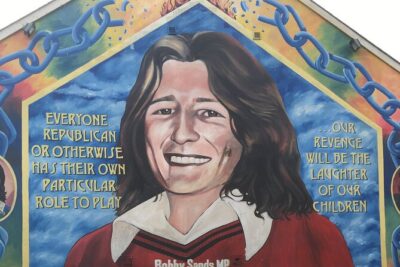
Private Tour: Giant’s Causeway, Norman Castles, and Game of Thrones Film Locations
Read our review →